The Holiday Stock Trap: Why Q4 Orders Break Q1 Cash
It's July.
I know.
Bear with me.
Because the founders who get Q4 right start thinking about it now. The ones who get it wrong start thinking about it in September, when the pressure is already on and the decisions have already narrowed.
Here's the short version: your cash conversion cycle — the gap between paying for inventory and actually collecting the cash from selling it — doesn't stop at December 31st. It runs straight through Q1. A Q4 purchase order that looks like a win on your P&L can quietly break your cash position two months later, if you haven't modelled where that cash actually lands.
I've been running COR Silver for eighteen years. We manufacture skincare in South Korea, sell on Amazon and through our own Shopify store, and ship via our 3PL partner. Every year, without fail, August arrives with the same feeling: the Q4 excitement, the Amazon velocity data, the inbox filling up with supplier lead time reminders. And every year, there's a purchase order that's significantly larger than anything else I'll write all year.
Some years, I got it right.
Some years, it looked right on paper … yet wasn't.
This article is about the difference between those two kinds of years. Not in an abstract “lessons learned” way, but in a mechanics way. Because the mistake isn't usually a bad decision. It's a decision made without understanding what the cash is actually going to do over the next seven months.
The feeling isn't wrong. The timing is.
Here's what Q4 ordering season feels like from the inside:
The sales data from last year looks encouraging. Amazon is signalling strong velocity. Your supplier is nudging you about lead times. There's a buyer conversation happening, or a wholesale opportunity, or just the reasonable expectation that November and December will be your biggest months.
All of that is real. The opportunity is real.
The problem isn't the opportunity. It's that excitement and urgency are doing the financial modelling … and, well … they're not very good at it.
The purchase order gets written at a size that feels commensurate with the opportunity. The assumption, usually unstated, is that the sales will happen, the cash will come in, and everything will work out.
Sometimes it does. Often, there's a gap between what the P&L records and what the bank account experiences. That gap has a specific shape and a specific cause.
What Is the Real Cost of a Holiday Purchase Order?
Let's run the numbers on what actually happens when you place a large Q4 order.
Your cash conversion cycle (CCC) is the number of days between paying for your inventory and collecting the cash from selling it. For most bootstrapped product founders, this sits somewhere between 60 and 120 days … often longer once you factor in payment terms with suppliers, shipping time, receiving and processing, and the lag between sale and settlement. (If you want to see your own number, I've built a free calculator for exactly this — more on that below.)
If your CCC is 90 days and you're ordering in August, here's the cash timeline:
August: You pay the deposit, or the full invoice, to your supplier
September–October: Goods are in production and in transit
November–December: You're selling. Revenue is being recorded. The P&L looks great.
January: You're collecting. But if you're selling wholesale or through retail, payment terms mean some of that cash doesn't arrive until late January or February
February–March: The full amount of cash from Q4 finally lands
By which point … and this is the part that catches founders off guard … your Q1 reorder is already due.
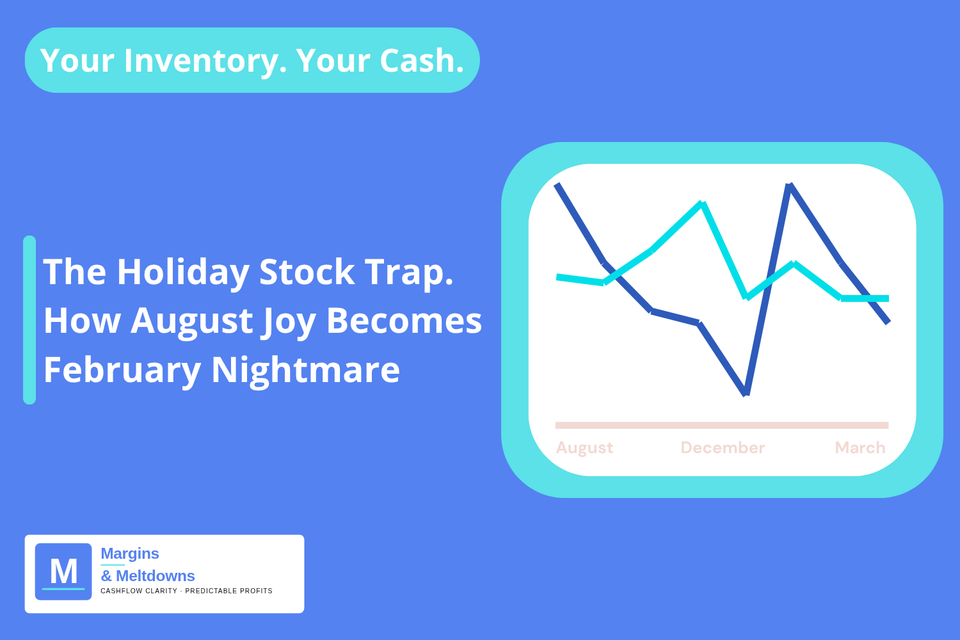
You're not running one cash conversion cycle. You're running two, in overlapping windows. The cash from Q4 comes in, and immediately goes back out. The holiday season shows up as a win on the P&L. The bank account tells a different story.
This is why founders don't usually fail in Q4. They fail in Q1.
The invoice from your supplier is not the cost of the order. It's the starting point.
Once you add what it actually costs to get that inventory into a sellable position in November, the numbers shift. Here's what a landed cost calculation looks like for a Q4 order with a tight delivery window:
Air freight — because sea freight won't arrive in time. Air freight from South Korea for COR Silver runs meaningfully higher per unit than sea. For your business, this number will be different, but it will always be higher than you want it to be.
Duties and customs — based on landed value including freight, not just the product cost
FBA receiving backlogs — Amazon's inbound receiving slows in October as sellers flood the warehouses ahead of Q4. If you're not accounting for the delay between your goods arriving at the fulfilment centre and being available to sell, you're carrying inventory that's costing you money and not yet generating revenue
Carrying cost — the cost of holding stock that won't move until November. This is real money, even if it doesn't appear on an invoice.
The purchase order that looked like it would fund a great Q4 looks different once you've added all of that. The margin per unit changes. The break-even point changes. And the cash position you need to be in before you write the PO changes.
If pricing is also part of what's making this tight, Price Yourself Paid covers how to build a price that actually accounts for this — worth a read alongside this one.
SKU discipline is not pessimism
Not every product deserves a Q4 order.
This is probably the most useful sentence in this article, and the one most likely to be ignored, because the instinct in Q4 is to stock everything, cover every possible sale, even create brand-new “holiday” skus, and not leave opportunity on the table.
But inventory you order in August and don't sell until December is cash you tied up for five months. Inventory you order in August and don't sell until February is cash you tied up for seven months, at which point you've paid for it twice (once on the PO, once in the carrying cost and the Q1 cash crunch).
Tighter SKU discipline going into Q4 means:
Identifying your two or three highest-velocity, highest-margin products and ordering those with confidence;
Being honest about which SKUs have marginal velocity and letting them run down rather than restocking;
Staged ordering where your supplier allows it — a smaller initial order with a confirmed replenishment window rather than one large bet.
This isn't leaving opportunity on the table. It's protecting the cash you need to still be trading in April.
The cash flow forecast that ends in December is a fantasy
If your Q4 planning involves a forecast that runs to the end of the year, you're only reading half the story.
The full picture of a Q4 ordering decision runs to March 2027. It emerges through the returns window, the January reorder, the post-holiday cash trough, and the point at which you actually know whether the season was a win.
A cash flow forecast for this season should show you:
When the cash goes out (the PO, the freight, the duties);
When the goods arrive and when they're available to sell;
When the sales happen and when you actually collect;
What your cash position looks like at the end of January, at the end of February, and at the end of March;
Whether you have enough left to fund Q1 without stress.
A question for you: How far out are you currently running your cash flow forecast? A month? A quarter? To the end of the calendar year? I'd genuinely like to know. Drop your answer in the comments. Because next week I'm releasing a tool that will let you run this forecast yourself, and I want to know where you're starting from.
What I'd do differently (and what I do now)
The years I got Q4 wrong at COR Silver weren't the years I made bad decisions. They were the years I made reasonable decisions without running the full cash picture, without knowing what my CCC actually was, without modelling the landed cost properly, and without forecasting past December.
What I do now:
- Calculate the CCC before I write the PO — not after. If you don't know your cash conversion cycle, you don't know the real cost of the order.
- Model to March, not December. The forecast runs through the full return of the holiday cash and the first Q1 reorder. If the model shows stress in February, I adjust the August order … not the February plan.
- Apply landed cost before I decide on quantity. The margin calculation uses the full landed cost per unit, not the supplier invoice. Air freight, duties, receiving, kitting, carrying — all of it in before I decide how many units to order.
- Choose SKUs deliberately. Two or three products get the Q4 order. The rest run on existing stock.
The holiday season is a real opportunity. It's also the single biggest cash flow decision you'll make all year. It deserves more than an optimistic spreadsheet and a feeling.
Speed the Cash — free calculator, live now.
Enter your email to get instant access to the cash conversion cycle calculator that’s behind everything in this article.
Get Speed the Cash →And next week, I’m publishing the tool that lets you forecast your cash flow all the way to March. Watch for it.
Jennifer McKinley is a cash flow strategist and the founder of COR Silver, a premium skincare brand she has run for 18 years. She holds an MBA from Yale and has navigated tariffs, air freight, Amazon FBA, and every cash crunch a bootstrapped, inventory-based business can produce. Margins & Meltdowns exists because the gap between a great P&L and an empty bank account is where product businesses quietly die — and it doesn’t have to be that way.


Member discussion