Profitable on paper. Short on payroll.
Most of my clients work with me for 8 weeks and then they are good to go: financial management cadence in place with simple, intuitive frameworks that are understood, and supporting tools customised to their business and fully implemented.
That’s by design. My job is done. You don’t need me as a crutch.
There’s a part of me that’s always a little sad about it, because these are people making genuinely good things and getting them out into the world, and I stop hearing what they’re up to.
Every so often, though, one of them rings in a panic. The call last month was from David, a client from a couple of years back who has been doing really well since. He didn’t think he was going to be able to run payroll. Nothing had gone wrong with the business. He was having an excellent year on revenue. His pricing was on point, his margins were solid.
However, three things, all outside of his control, occurred at once. Not one, but two, of his customers let him know that they would be late on their payments to him, and he had received a pretty large order of his best-selling SKUs and needed to order in extra of a key ingredient, paying upfront, in order to fulfil it. Net effect: he wasn’t sure he would have enough for payroll.
His question to me: how is it that, even though I’m solidly and consistently profitable on my P&L, these three seemingly smallish events mean that I’m short of cash?
The answer nobody explains properly
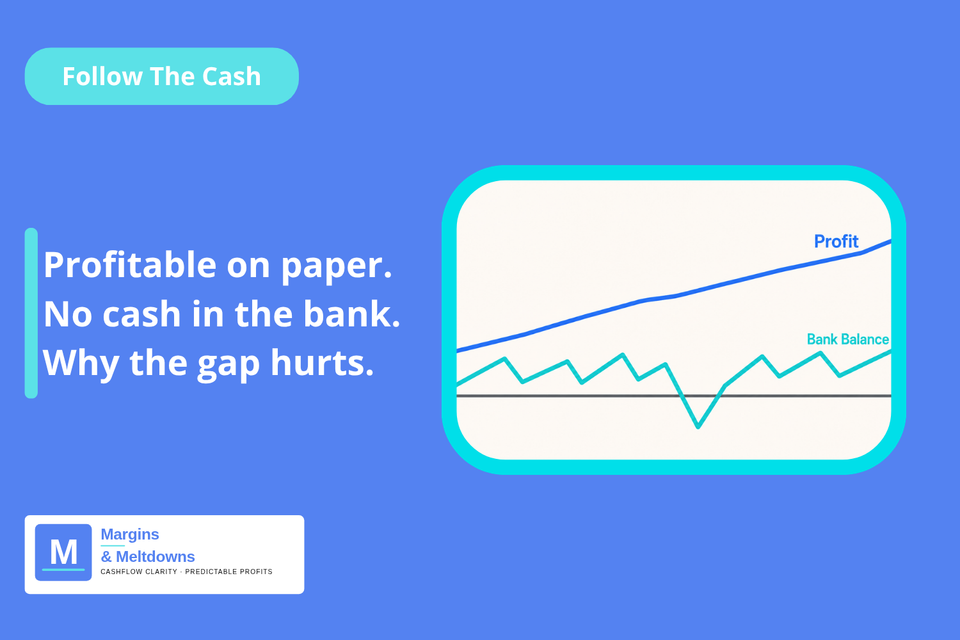
It’s a good question and one that so many inventory-based business owners ask all the time. The simple answer: accounting software and the resulting P&L statement is measuring accounting profits, whereas to fully understand cash profitability, you need to be looking at the cash events happening on the balance sheet too. Profit on a P&L largely tells you “am I selling my goods or services for more than they are costing me?”. What it doesn’t tell you is what my bank account cash balance is on any given day. Cash in. Cash out. That’s the gap. That’s why a business can look robust in the accounts and still have a week where the bank account doesn’t cover the payments.
Two things David already had
Here’s where our call went from fear to fun. I explained to David that he didn’t really need me. He already had two pieces of information that we had set up previously that would give him clarity on his options. But in his panic, he had forgotten to look them up.
- First, we pulled up his Predict the Cash 13-week forecast. We immediately saw that there were two cash events he could delay relatively easily without consequence, and one customer who had a large invoice outstanding that he could call to chase.
- Second, we looked at what was sitting in his buffer account. Part of the process we put in place two years ago was to set up a weekly allocation into an account to build up cash reserves. He has nicknamed the account “Oh shit moments”.
Between those two things, we saw he could make payroll, and only be short of cash for a relatively short two week period, and his “Oh shit moments” account could easily cover the shortfall. The call took all of 20 minutes. Panic over.
The bit that matters most
David doesn’t have an accounting background. In fact, in our first session he said to me “I’m going to be a tough client … I’m terrible with numbers. I would rather do literally anything else other than look at my accounting statements.”
But the Predict the Cash tool was one that we spent 40 minutes customising to his business. And he immediately saw how simple and intuitive it was for him to use. One session. He was up and running immediately.
Because when looking at cash flow forecasting, you’re looking at a calendar of events, not a financial statement.
Why I built Predict the Cash in the first place
It’s the thing I got caught out by, repeatedly, in the early years of COR Silver.
I make skincare. Production runs can total upwards of US$50,000 at a time. I started the brand in the middle of the 2008 financial crisis, which meant no line of credit was available to me — and I still don’t have one, though these days that’s a choice rather than a constraint. Eighteen years of that has been an ongoing exercise in deep breathing and tightrope walking.
There is nothing structurally wrong with an inventory business and its sometimes very tight cash flows. It’s not a result of any mistakes. It’s just a fact of running an inventory-based company. Cash goes out the factory door for ingredients, packaging, assembly labour, freight, tariffs. Cash comes back in months later based on the retailer’s terms. No mistakes; just a straightforward structural gap in cash flows.
To deal with it, I did two things:
- I opened up a bank account and nicknamed it “Materials and Inventory”. Every week, a percentage of incoming cash gets allocated into it. When I raise a purchase order now, the money is already sitting there. PO raised, order placed, funds wired. No drama.
- I built a fairly involved spreadsheet to forecast my cash. I update it every week after I have done my bank account allocations. This gives me visibility into not just the amounts of cash coming in and going out the door, but more importantly the timing of those incomings and outgoings, all tied to my various Profit First bank accounts.
It only takes me 15 minutes a week to update, but it gives me the visibility into when I might be experiencing low bank account balances, even if I’m still showing robust profitability in my P&L. It allows me to make decisions about moving cash events to smooth the cash flows long before it becomes a crisis: move a payment, chase an invoice, delay a marketing campaign by a few days.
That spreadsheet has now been replaced by my Predict the Cash 13-week cash flow forecasting tool that I now use with clients. It’s what I use still in my own business every week.
Who it’s for
You, if you are a small business owner that has lumpy cash flow timing. Most physical product founders experience this because they are paying for stock months before it comes back into the business as payments. Quite often, physical product founders also have seasonal peaks or are trying to decide when is the ideal time to launch a new product, not just from a marketing standpoint, but also from a cash-out-the-door-to-pay-for-the-launch standpoint.
It’s not necessarily for everyone though: if your revenue arrives in a steady monthly pattern with no inventory to fund, this is likely overkill. And if you already have a system to forecast your cash and it’s working, great. Keep doing that. You might still want to have a look at it though if your cash flow forecasting is not tying back to your specific-purpose bank accounts.
Back to David
Here’s someone who had the information and tools he needed to make the right decisions. He didn’t actually need to pick up the phone to talk to me, or his accountant, or anyone else. He simply needed to take a deep breath, calm down and open the tool to look at the options. That’s what it is there for … so he (and you, if you are using it) can see the crisis six weeks from now when you still have inexpensive options.
If the tight week isn’t your bottleneck, it might be one of these:
Follow the Cash — for when you can’t see where the money is actually going.
Speed the Cash — for when the money is coming, just far too slowly.
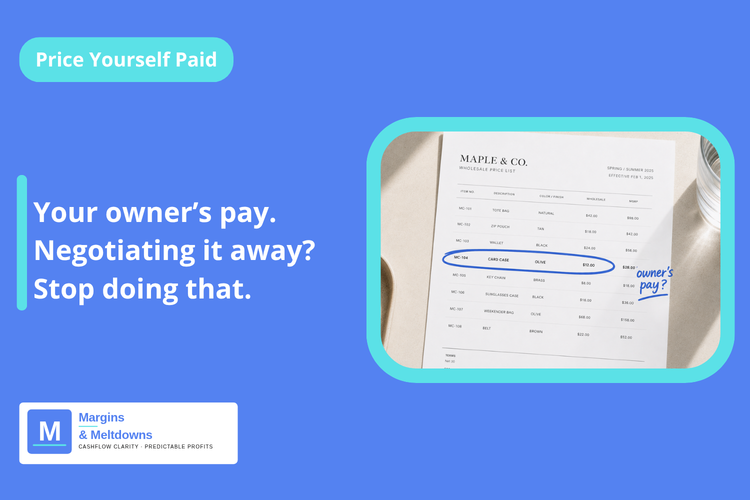
Price Yourself Paid — for when the maths only works if you don’t pay yourself.
All four sit in the Toolkit.
Jennifer McKinley is the founder of COR Silver, the premium skincare brand she has run for 18 years, and the cash flow strategist behind Margins & Meltdowns. She holds an MBA from Yale and has had two prior business exits. She works with bootstrapped physical product founders in New Zealand and the United States on cash flow, pricing and inventory, using the cash envelope or bank account allocation methodologies like Profit First or YNAB. She splits her time between New Zealand and Maryland.



Member discussion