The only line in your costing you’ve ever been flexible about
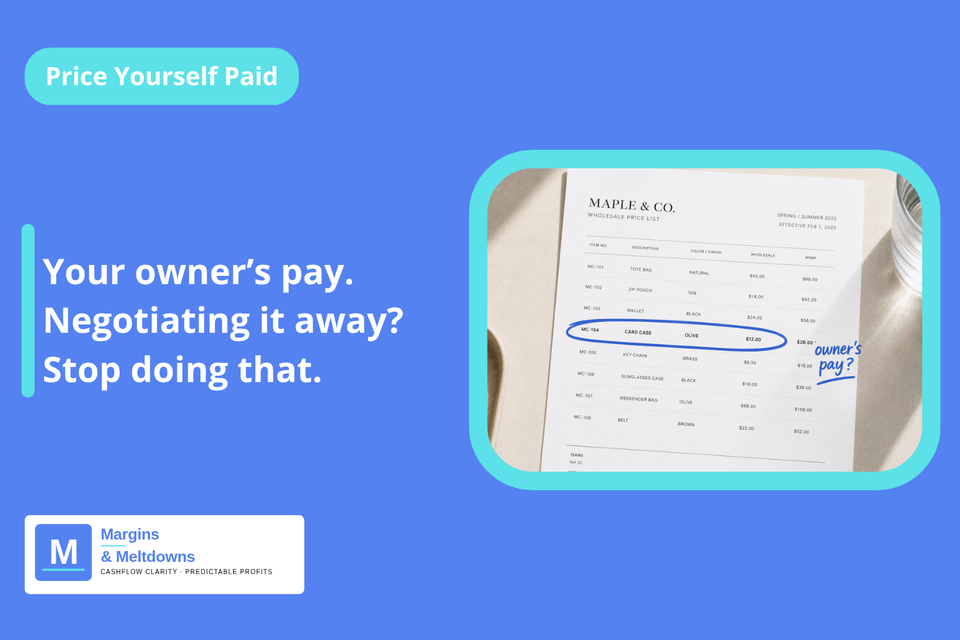
I was working with a client this week, reviewing her pricing. She’d just been approached by a well-known, high-end US chain wanting to bring in one of her SKUs.
It was a tricky conversation.
And it turned into a perfect example of something I see constantly with founders: owner’s pay is the one line item that gets negotiated away first, and almost nobody notices it happening.
The deal that nearly wasn’t worth taking
She’d left me an excited voicemail with the news but wanted to review the pricing they were insisting on. So we pulled up my Price Yourself Paid tool, plugged in the numbers and… womp, womp, womp. After their margin cut and the customisation they required in packaging and labelling, there was so little left over to cover her other costs — the ones that are supposedly non-negotiable — that it hardly seemed worth having the next conversation with the buyer.
It was a proper Debbie Downer moment, and one my clients hit all the time.
She tried to negotiate with me to justify taking the account anyway. When I pointed out there was so little gross profit left that it wouldn’t move the needle on her bottom line, she said: well, it’s not much, but it’s something. So we stripped out the tax allocation — that’s the government’s money, not hers — and looked at what was left for operating expenses.
After that, there was literally nothing left for owner’s pay.
She still wanted to do it.
The question that stopped the conversation
So I asked her a simple question: how is it that the one thing that’s completely negotiable in your pricing is paying yourself?
That stopped the conversation cold.
We had a proper talk about why that is and what she could do about it. We gathered her numbers, and she went back to the buyer with her bottom line — one that included a decent (not outrageous, just decent) gross profit with room for owner’s pay.
The buyer was impressed she knew her numbers that well, and that she could articulate exactly what she needed to make the partnership work. She landed the deal at the right price.
Here’s the part that stays with me: if she hadn’t run the numbers first, she’d have taken that deal on excitement alone — the retail logo, the validation, the “household name” of it all. She’d have shipped product to a big-name chain, done all the customisation work, hit her sales target on paper, and paid herself nothing for it. That’s not a hypothetical. That’s the default outcome for founders who don’t check first.
Why is owner’s pay the first thing founders give up?
It’s not the first time I’ve had this conversation with a client. And it got me thinking: why is owner’s pay the one line item founders negotiate away first?
According to Bluevine’s 2026 Small Business Burnout Report, 62% of small business owners have reduced or skipped their own pay at least once in the past year, and 21% have done it four or more times. I’ve done it myself, especially in the early years of building my skincare brand. I even created a line item on my balance sheet called Deferred Owner’s Compensation — telling myself that one day I’d pay myself back for all that hard work.
What I do now
I don’t do that anymore.
Now owner’s compensation is hardwired into every pricing decision. Non-negotiable. Constant. Every SKU I sell contributes not just to the cost of running the business, but to the cost of running my household.
It didn’t happen overnight. I started by adding 1% for owner’s pay, then slowly increased it to a number that actually works for me.
And that deferred compensation bucket on my balance sheet? I opened a bank account, nicknamed it Owner’s Buyback, and hardwired 5% into pricing for that too. Eight years on, the account had done its job, and I quietly closed it.
If you’re struggling to make owner’s compensation non-negotiable in your pricing, take a look at the tool I just launched: Price Yourself Paid. It might give you the clarity — and the permission — to push back on the pricing being asked of you.
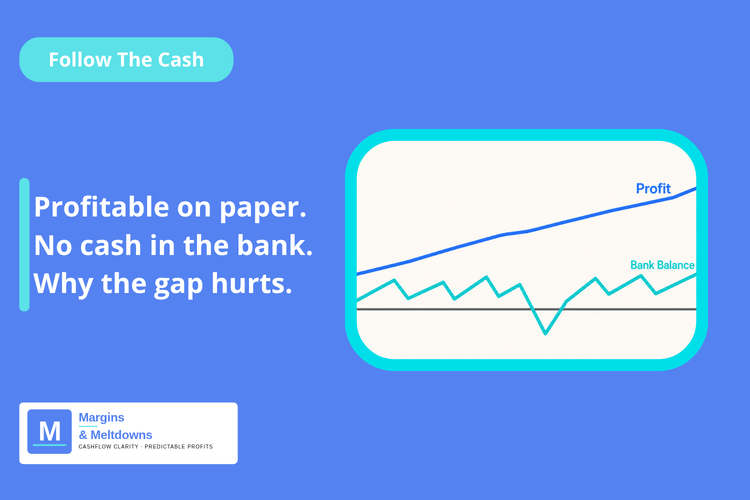
Related: Profitable on paper. Short on payroll. — why a healthy P&L and an empty bank account are not a contradiction.
Jennifer McKinley is the founder of COR Silver, the premium skincare brand she has run for 18 years, and the cash flow strategist behind Margins & Meltdowns. She holds an MBA from Yale and has had two prior business exits. She works with bootstrapped physical product founders in New Zealand and the United States on cash flow, pricing and inventory, using the cash envelope or bank account allocation methodologies like Profit First or YNAB. She splits her time between New Zealand and Maryland.

Member discussion