
Your Accountant Isn't Wrong. They're Just Answering the Wrong Question.
Quick disclaimer before anyone assumes I'm throwing shade on accountants. I'm most definitely not. I'm trained in accounting. My first accounting class was in high school. I carried on during my undergraduate degree in International Finance and carried on during my Yale MBA. (Even took on tutoring for other students who were struggling with accounting and was a TA.) I actually love this stuff. Accountants do genuinely good, necessary work.
Accounting is logical and it's methodical. It helps organise a company's financial information in a way that is really useful…
…and it is really hard to understand for many people, including so many of the truly creative and innovative entrepreneurs and founders that I work with. Most of them have mastered reading their profit and loss statements. Good. That's excellent information. But (and this is a big BUT), it's not the full picture of what's actually happening to the cash in the business. For that, you also need to be analysing your balance sheet, and your statement of cash flows.
Why Doesn't Anyone Tie Their P&L, Balance Sheet, and Cash Flow Together?
Which is interesting: I haven't had a single client in the last 7 years who has tied all three financial statements together on a consistent basis. Not because they don't want to, but when they are stretched so thin building a consumer brand from scratch, with a skeleton team, there just isn't enough time in the day for learning that skill and applying it consistently.
So what do they do instead? They defer to their bookkeeper and/or accountant. Or they simply look at their P&L statement and their bank balances. And make decisions based on those two incomplete pieces of information.
Oftentimes they listen to what their accountant is telling them. Which, if we're being honest, might not be giving the most useful information. It isn't that your accountant is wrong. It's simply that they are answering a different question from the one you actually need answered.
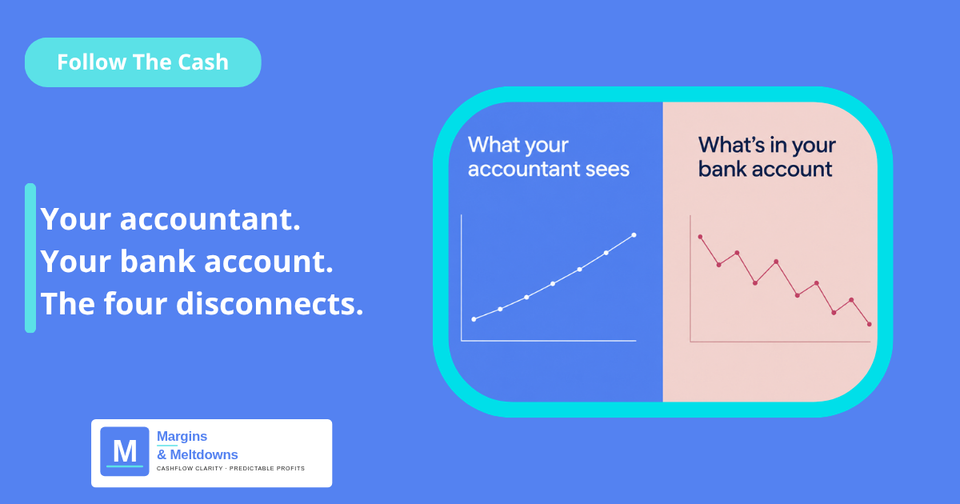
Accountants are looking at historical information. They are ensuring you are compliant from an accounting and tax standpoint. They are telling you if you are profitable, from an accounting standpoint — not from a cash standpoint.
What you want to know is “can I afford this production run?” or “can I afford to hire this new person to do this role?” or “how much can I spend on this quarter's advertising budget?”
I lived that exact question. My best year ever at COR Silver — several years of double, one year of triple-digit growth — and I was launching into Japan, which meant my biggest production run to date across every SKU. Best year ever, on paper. And I still had to fund that production run out of my own personal savings, because there wasn't enough cash sitting in the business bank account to cover it.
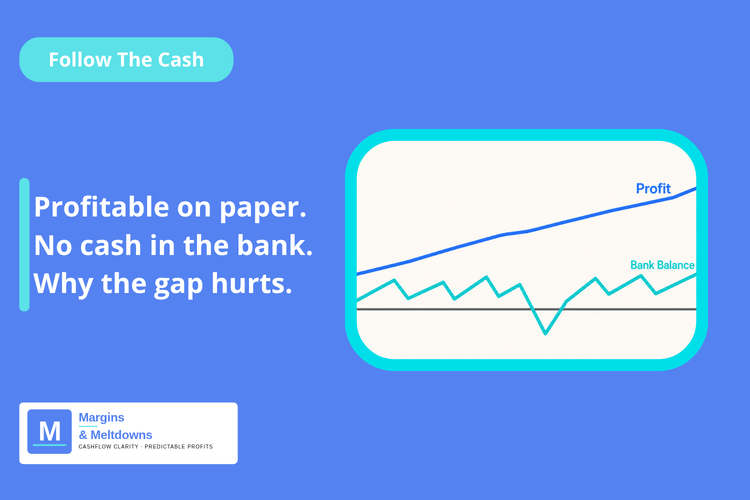
The gap between “on paper” profitability and true “in the bank” cash profitability is where inventory-based founders find themselves murky on understanding their numbers and how to move forward.
So I thought I would help explain some of the things I get asked about after a client has had a meeting with their accountant, as they might be things you are wondering about too. Let's explain these misnomers without using any accounting jargon. And let me know if there are other questions you might be wondering about too — ones you've been too scared to ask your accountant, or that simply don't make sense to you with your highly creative, entrepreneurial brain.
If you want a starting point for tracking this yourself, our free Toolkit has the cash flow tools I use with clients every week.
The Question That Actually Matters
Your accountant is answering your questions in a technical way. And so they might not be answering the question that truly matters to you. Accounting tells you if you're profitable. It doesn't tell you if you can make payroll Friday. That gap is where inventory businesses die quietly.
Every week, Margins & Meltdowns breaks down the real cash flow and operational patterns behind bootstrapped, inventory-based businesses — free, straight to your inbox.
Subscribe freeSo, over the next few weeks, here's what we're going to cover:
- “You're profitable, so you're fine.” The reality: accounting profit is very different from true cash profit. You can be showing steady profitability on paper while there is close to zero in the bank account. It depends on where you are in the inventory purchasing or production cycle compared to where you are in the accounts receivable cycle. Inventory has sold but it's sitting on a retailer's shelf and they don't have to pay you for the next 30 or 60 days.
- “Just look at your P&L to see how you're doing.” The reality: the P&L doesn't show inventory purchases as an expense when you buy. It shows them as COGS when you sell. So a big reorder for your next production run can wipe out your bank balance in a month that your P&L says was great. Founders who only check the P&L get blindsided by their own bank account.
- “Just keep growing revenue and the cash will follow.” The reality: revenue growth doesn't fund itself — it eats cash before it gives any back. Every extra dollar of sales usually means a bigger reorder first: more inventory bought and paid for weeks or months before it sells through. Your top line goes up, your accountant's happy, and your bank balance is doing the opposite of what you'd expect.
- “Don't worry about your taxes. We will make sure it won't be much.” The reality: accountants want you to have as low a tax bill as possible. You want to have a solidly profitable business (on a cash basis) so you can pay yourself and provide for your family. That's a disconnect.
Stay tuned and subscribe to get more details on each of these topics. And message me if there's a question you have about something your accountant told you that doesn't make sense to you. I read every message and will add your question to the series.
Every week, Margins & Meltdowns breaks down the real cash flow and operational patterns behind bootstrapped, inventory-based businesses — free, straight to your inbox.
Subscribe free

Member discussion