Why Bootstrapped Owners Can't Just Take a Week Off
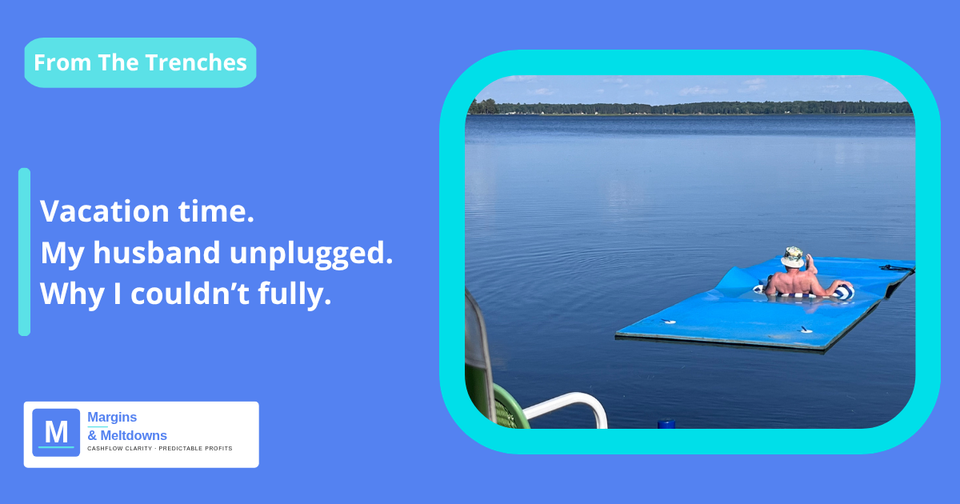
I needed a break. There. I said it. And yet, even though we had booked the trip and arrived at the most peaceful lakeside residence in Northern Minnesota for a week of “unplugged-ness,” the unplugging didn’t actually happen.
My husband is an employee. A really successful employee. In a really stressful job. Yet, when we go on vacation, he can unplug (mostly; maybe about 80%).
Me? Nope. I have two businesses – my skincare business of 18 years (COR Silver) and my consulting business (Margins and Meltdowns), and even though both run relatively smoothly because all of the infrastructure supporting it is already in place, it is simply impossible for me to completely dip out, as I wanted to do that week.
I wanted to dip out of work and dip into swimming, kayaking, reading, playing golf, hiking. And it didn’t happen.
Why I Couldn't Actually Unplug
Don’t get me wrong. I did slow down that week. I had scaled back my meetings bar two: one with a client that needed to happen due to what was going on with their business and another to teach a workshop on cashflow management to product founders. I also did some strategic planning and worked on some code for my CFO analytical tools.
You could say it was a slow week, but not an off week which is what my body and mind felt like they needed. Because what didn’t slow down was my need to log in every day to check my emails, my orders, my fulfilment of those orders, my answering questions for clients.
And mostly, what didn’t slow down was my mind. I know I’m not alone: according to a Patriot Software survey, 53.5% of small business owners lose sleep over their business at least a few times a week. They also found that 84.4% have personally sacrificed their health, relationships, or mental wellbeing for the business. That’s alarming.
Could Your Business Survive Four Weeks Without You?
In plain terms: if you couldn’t be reached for four weeks, would your business survive, stagnate, or fall apart? That’s the diagnostic question Mike Michalowicz poses to small business owners — and it’s one I’m a fan of.
For my product business, it would survive but wouldn’t thrive.
For my consulting business, it would fall apart. Without me, there is no business. People are buying me. They are buying access to one-on-one advice from me.
I've Built This for a Client. Just Not for Myself.
Here’s the irony: I have actually asked this same question of several of my clients and helped them prepare for their own four-week vacation. What does that look like? It means architecting the business and its processes so that the owner can disappear and the employees know what still needs to happen, how to make it happen, and what to do if it doesn’t happen.
Interestingly, my own brother and brother-in-law implemented this approach in their company years ago. There are three owners and every year, one of the owners takes a six-week sabbatical, while the remaining two cover. With my client, there is just one owner, but with a full team of really capable employees. With that structure, unlike my brother’s, the preparation work and the experiments were critical to making this work.
Sounds simple, right? No. It took months of preparations, months of discovering, documenting (through SOP videos), improving upon, re-documenting (more SOP videos), and implementing the new roles and SOPs. It was then tested with a one week vacation. What worked? What didn’t work? Revise. Test it with a two week vacation. More refinements.
Finally, my client, and her employees, were ready to embark on the four-week dream vacation to Japan.
One of the fascinating side benefits of working towards this vacation goal lies behind the idea that not only do you, the business owner, need a break from your business sometimes, but sometimes your business needs a break from you! For my clients that have done this, they report coming back to a team with new ideas and new ways of doing things. Without the constraint of “it’s how I’ve always done this as I built the company,” the team is able to look at operations with a fresh set of eyes and mindset. It can create really wonderful growth and innovation.
If you're a physical product founder wondering whether your own business would survive without you, that's exactly what we dig into here every week.
Subscribe freeWhy the “Clockwork” Model Doesn't Fit Solopreneurs
So, if I’ve seen my family members do it with their business, and I’ve worked with clients to architect it for themselves to take the vacation, why can’t I do that for myself? Irony upon irony: it was this thought that kept my mind racing while on our vacation this August. It’s the thing I can’t stop thinking about now. But it also highlights why the “Run Like Clockwork” approach laid out by Mike Michalowicz and Adrienne Dorison doesn’t work for solopreneurs like me.
Simply put there’s no one to hand the work to. While I can help my clients get there, I’m an edge case for the framework.
What I'm Actually Doing About It
There are things I can do though to allow more of a slow down when I take time off. And that is guiding some of my strategic projects for the next quarter. Not “hire a team.” That’s not part of my goals (been there; done that; don’t want or need to do it again). It’s what are 2-3 small changes I can make that get me closer to the goal without sacrificing why my clients work with me. These are falling into three buckets:
- Process changes
- Product changes
- Roles and responsibilities changes through partial delegation to outsourced partners, a VA and even AI
Once I have fully tested these changes I will come back and let you know what they are and what resulted from them …. after my first fully-unplugged vacation of course!
If you are stressing about your business and would like to figure out how to take a deserved unplugged break, reach out. In the Patriot Software survey of small business owners, only 30.8% say they love entrepreneurship and can’t imagine doing anything else; 42.2% are exhausted but staying anyway. Let’s make sure you and I are both in the 30.8% and not the 42.2%.
About Jennifer
Jennifer McKinley is an 18-year product founder sharing real lessons from running COR Silver, her bootstrapped skincare brand, and Margins & Meltdowns, her cash flow consulting practice for other physical product founders. She holds an MBA from Yale and has navigated two prior business exits, the GFC, a global pandemic and its supply chain chaos, tariffs, air freight from South Korea, and Amazon FBA. She knows firsthand what it takes to build sustainable cash profitability in a lifestyle business that pays its owner first. Honest stories, practical finance tips, cash flow systems, and tools that actually work — for founders tired of everyone else getting paid first.
Every week, Margins & Meltdowns breaks down the real cash flow and operational patterns behind bootstrapped, inventory-based businesses — free, straight to your inbox.
Subscribe free

Member discussion